

Issue#39 Course-correction
Hari's immigration journey and why not getting an H-1B is not the end

This Immigrant Life has lots of free issues for you. But they are not free to produce. This article is the product of a planning, scheduling, interviewing, writing and editing process spanning several weeks.
What you support, will thrive. Consider a subscription or a one-time donation using the link here.
Thanks for your support.
And now…let’s talk to Hari Prasad Renganathan!
The day Hari received the news was a bit surreal.
Things had been decided - he was going to Georgia State University. He pictured himself in Atlanta. He knew what was next.
And then it all changed.
An email. A link. A page with falling confetti 🎊
Hari had received an admit from Columbia University. Moments like these have a way of changing the background score of life.
And it did, just not in the way that it was planned.
An important thread that runs through Hari’s story - A strong sense of where you are going. If you’re in the middle of a challenging immigration journey, this story is especially meaningful.
I wonder what happens when you pull this lever…
A bright international student attends a globally renouned Data Science program at an Ivy league institution. He gets a job, settles into life in New York. He’s paid off his massive student loan in just a few years and now dreams of building his own company.
Naturally, the next logical step is to throw him in with everyone else who wants a work visa, irrespective of merit, and run them through the trusty bureaucratic slot-machine.

And around and around Hari went on the H-1B till he hit a plot twist: Hari’s last attempt at the H-1B had failed.
Ask any international student who has walked a few miles on Immigration Blvd. They’ll tell you that as you toss your graduation cap in the air, you hear this rhythmic sound. That’s the immigration clock starting its relentless ticking.
And when the last attempt at H-1B fails, the ticking clock gets a lot louder.
I didn’t expect it would happen.
Even though probabilistically, logically, mathematically it could — we all knew that. But there’s a difference between knowing something could happen and knowing anyone who’s actually gone through it.
And when I got the news, I realized that everything was going to come to an end — having that job, being in New York, being in the US. I’d have to go back into job search mode in a different country, a different role.
That was really shocking.
At this point, the more jaded readers will (smugly) think that this should not have been shocking at all. Every international student knows that running out of road is a possibility. This argument frequently meets Hari in the comments when he shares his story.
But seeing a fist coming, doesn’t leave your nose any less bloody.
Hari was in a bind. He had no Plan B in place.
Not getting an H-1B is far from a unique situation. Thousands of international students find themselves in Hari’s shoes every year. Desperation takes over and the creative solutions kick in:
Going back to school is a typical one.
This is where Hari departs the well-worn path.
He did not give into that existential panic of preserving immigration status at any cost. He wanted to build a company in the US - but in THAT order. Building his own company took precendence over living in the US.
My goal was never just to get H-1B…I always had a goal of building something. I knew that getting an H-1B would only restrict me from doing that.
…If I’d gotten it, I knew I’d get lazy. I know people who keep saying “one day, one day.” I would have been that same person.
This clarity meant Hari sidestepped that insidious transition that happens in immigrant life - We go from getting a visa that lets us to do what we want, to doing what the visa lets us do.
I feel like people try to live their life with the visa as the boundary — they do everything the visa allows because that’s the set of things it permits. I think it should be the opposite. You should decide what you want to do, put that list together, and then get the visa that will support you to do that.
Ok, clarity is great and all, but his next step was still an open question. It would prove challenging to answer. The most obvious solution fell away quickly.
I thought my company would support me — unfortunately they couldn’t. So that was shocking. I thought, okay, I’m on my own. No one is going to support me right now. I have to figure out my next stage in life.
That was the scariest part.
I had no idea what I was going to do. I was trying everything — opportunities in the UK, Canada, going back to India, what would I do there — all of these things.
When in doubt, recalibrate
This is the sort of situation where practicality kicks dreams off the driver’s seat. That’s somewhat understandable. Turmoil reverses us into survival mode.
Remarkably, Hari quickly recalibrated -
Then I thought — if I’m going to a different country, I want to go somewhere I can build something. That’s why I was looking for startup jobs. That’s when I eventually got an offer from Saturn (a UK-based startup).
They said they would sponsor the visa — so I thought, why not? And everything happened in twenty days. They gave me the offer, I had the visa and the flight ticket within twenty days.
An interesting question to ask, when you’re building a life abroad is: “What am I optimizing for?”
There are no wrong answers here. You can optimize for earnings, a better life for your family, peace and security, a better environment for entrepreneuriship. Whatever…
But knowing what you are optimizing for? That’s the key. Hari knows what this is for him - freedom.
I know I want to be in the US — because of my background in tech and because if I want to keep working in AI, I want to go to Silicon Valley and maybe build a company or work in a startup. I want that. I don’t even have a visa to do that today. But I want to do it with my freedom intact.
Even if I get a business visa and come temporarily to build something, then go back — I prefer that because it gives me the flexibility to do whatever I want. I didn’t feel I had that option in my mind at the time.
He has also learned some valuable lessons -
…visa is not just one of the things that could block my career or my life. Visa is the main thing that can block your career and your life.
This realization has changed how Hari is approaching things in Immigrant Life 2.0.
I have a two-year visa even now, but I’m already looking at other visa options — there’s something called the Global Talent visa, which requires me to build a profile and apply.
I’m already working with a lawyer. I paid for that. I wouldn’t have done that before... But I have two years and I’m already starting because it became a priority.
Running immigration and entrepreneurship on parallel tracks is not the only way in which Hari is approaching things differently.
It also changed what I should be grateful for. I have this two-year visa. I know it gives me the freedom to build, so I should use that properly. I understand the value of time because of this. Every visa has a deadline, and whenever there’s a deadline, you’re more motivated, more mindful of every day you have — because of that deadline.
The visa gave me these thoughts about how to think about life.
Get building already…
Just a few years prior, Hari had landed in New York as an international student, 2 suitcases in hand. Now, a few years down the line, he downsized to the same 2-suitcase-life and moved to London.
Life had come full circle.
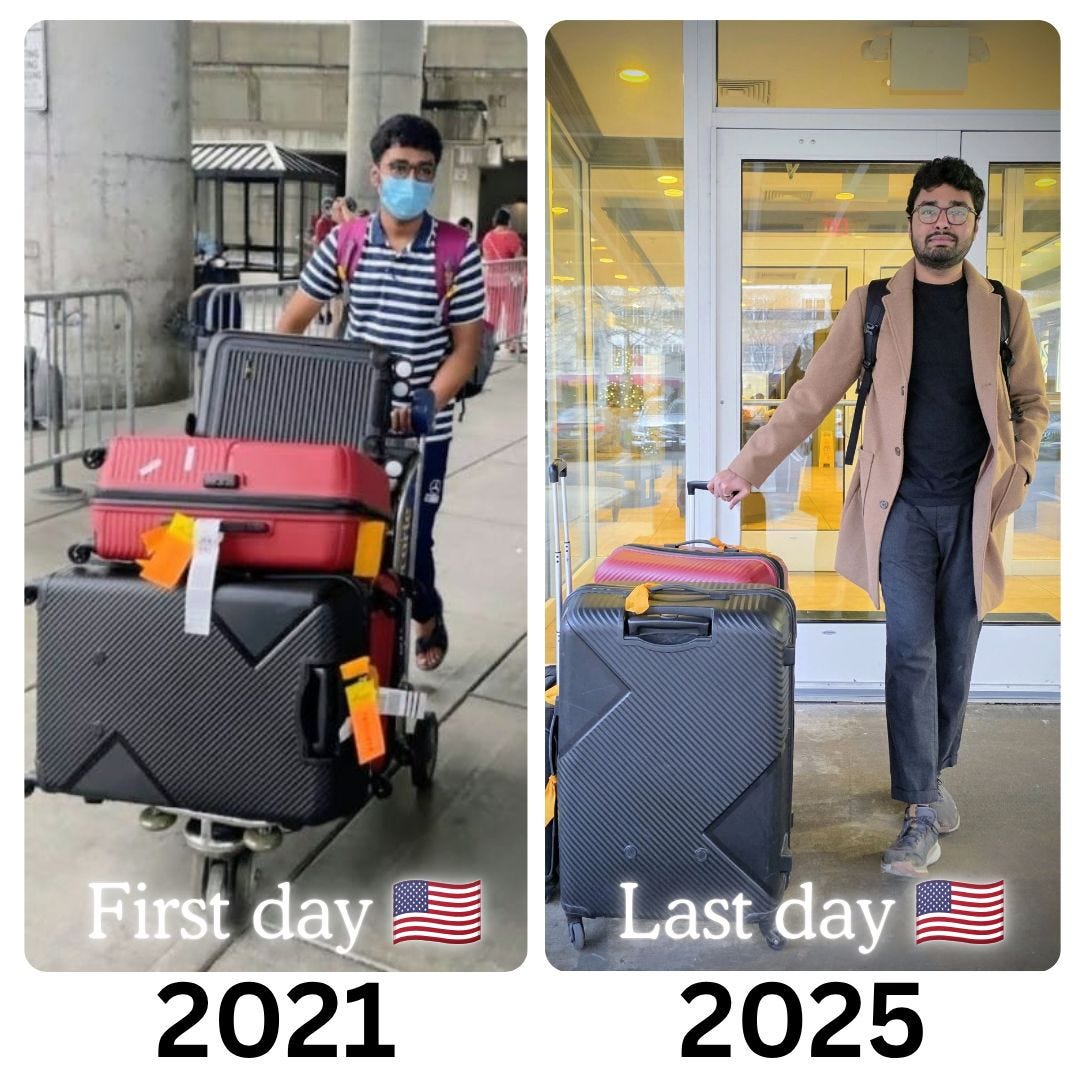
He settles in to life in London. Starts working at this amazing startup. He’s learning a lot. It all looks good on paper. But a familiar feeling gnawed at him - “Hari, you came to London to build, and you’re not building anything.”
This needed to be fixed.
I started looking for the right way to do this. I was applying to entrepreneur-in-residence programs — some VCs and accelerator programs, instead of funding you directly, take you in for eight to ten weeks or six months…
The only catch is you have to do it full time. You have to leave your job.
Entrepreneur-in-residence programs help you build a company — initially validate the problem statement, find a co-founder, all that stuff.
And so, he took the plunge.
I joined Antler with a different idea initially, and eventually it evolved into what is now Flax — an AI executive assistant for service providers. That means people who sit in a lot of meetings — lawyers, business coaches, anyone who talks to many people.
They love the actual work of talking to people, doing the real work, but they also have to take care of all the admin: replying to emails, following up, scheduling calendars.
It has been a bumpy road. But Hari is finally doing what he set out to do.
He boils down the challenges of immigration to one simple thing -
…the problem of being an immigrant is you don’t have a choice.
You live by the choices the visa gives you, and you can’t make your own. That’s the only problem. When people who aren’t immigrants criticize, saying “you’re living in America, why are you complaining?” — the problem is the [lack of] choice.
Once you have a family, you can’t just leave. You have to accept the terms. At the same time, the visa is restricting you from living your own life properly.
Such a simple thing, right? Choice. Having a say on the terms by which you live. Yet so many of us don’t have a vote on such a foundational element of our lives.
I wanted to share Hari’s story not because he has “solved” immigration. But precisely because he has found a way to work on his dream despite immigration challenges.
Hari shares writes about his experience on LinkedIn frequently as well. To convince you that there are other paths. There are ways to not let immigration kick dreams off the driver’s seat and let pragmatism take over.
He often hosts events that share resources on how to navigate immigration too.
There have never been more immigrant voices sharing resources and guidance on how to reshape your life into one that helps you reach your goals.
Going back to something Hari said before this article -
…visa is not just one of the things that could block my career or my life. Visa is the main thing that can block your career and your life.
At some point or another, most of us hit this realization. From that point on, there are 3 ways of dealing with it:
Resign: Do nothing and hope for the best
Rebel: Set everything else on pause and pursue immigration stability
Resist: Don’t let immigration stability stop you from building
I went the Rebel route myself. I threw myself into getting immigration stability. I moved to Canada on PR and I’m now a Canadian citizen.
Hari mixed things up between resisting and rebelling.
What route are you taking??
Guest Bio:
Hari is a Sr. AI Engineer & Founder at MyRealProduct. He’s an alum of Columbia University and has spoken on the TEDx stage. The story of his immigration journey has been featured in the BBC and other media outlets.
You can find him on LinkedIn here.